


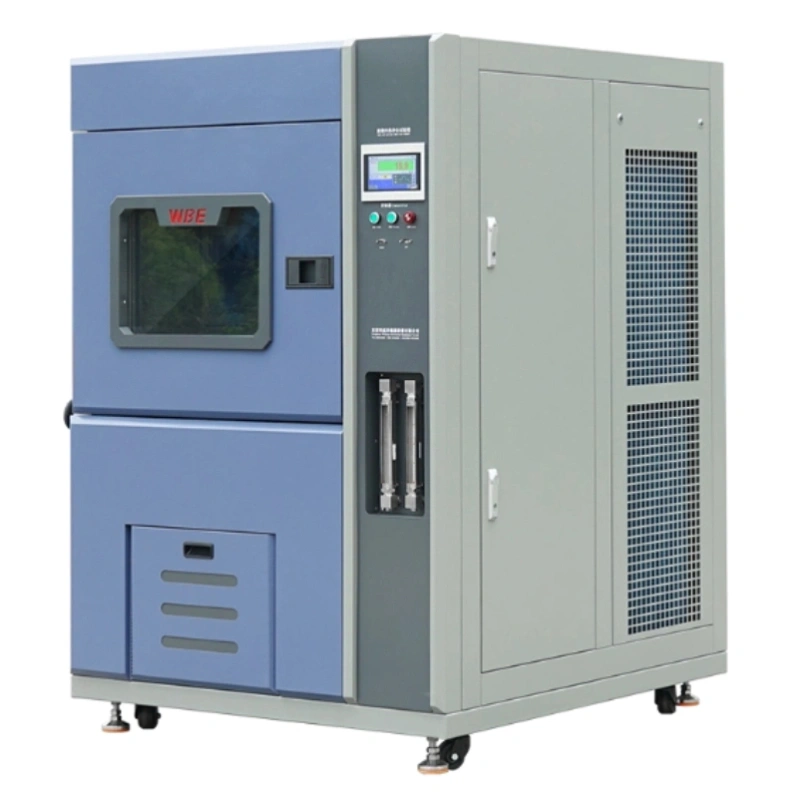
No standard tests your product. A profile does. A thermal shock test chamber only ever executes a small set of numbers you type into a controller, and every standard you have ever been handed is really a way of telling you which numbers to use. That is the entire trick, and it is why the same machine can serve a defence programme, a semiconductor qualification and a civil product file without contradiction.
This guide follows the order a test engineer actually works, not the order a standards list is printed in. We will cover five things in sequence: how any thermal shock standard collapses into four programmable parameters, what MIL-STD-810G asks a machine to do, what JESD22-A106B asks of a semiconductor package, what GB/T 2423.1 and GB/T 2423.2 ask of a civil product, and how to run several standards on one machine without corrupting the records. Then we put the whole mapping into a table you can keep next to the controller.
The short version, if you only read this far
- Every thermal shock standard reduces to four parameters: hot extreme, cold extreme, dwell time and transition time.
- Transition time is the parameter that eliminates machines, so it decides the structure before anything else does.
- When a method requires the sample to be powered during the shock, you need a structure that keeps the part still.
- Run several standards on one machine as separate records, never as one blended profile.
Step 1: Every Standard Reduces to Four Parameters a Thermal Shock Test Chamber Must Hold
Every thermal shock document we have programmed, from a defence method to a semiconductor qualification, comes down to the same four parameters. Once you see them separated like this, the differences between standards stop being intimidating and start being a reading exercise.
| Parameter | What it means on the machine | Why it decides the purchase |
|---|---|---|
| Hot extreme | The upper setpoint the chamber must hold with the load inside | Sets the heating capability and the insulation you need |
| Cold extreme | The lower setpoint the chamber must reach and hold | Sets the refrigeration stages and the pull-down time |
| Dwell time | How long the sample stays at each extreme | Decides whether the part reaches temperature, not just the air |
| Transition time | How fast the chamber moves from one extreme to the other | Decides the structure: basket, thermal storage or liquid bath |
Read the last row again. Three of the four parameters are about the profile, and any competent machine eventually holds them. The fourth one, transition time, is the parameter that eliminates machines, because a chamber that cannot change fast enough cannot be rescued by a better profile or a longer dwell. With those four dials in front of you, any specific standard becomes a matter of reading off values, so let us start with the defence document that most often sits behind a purchase.
Step 2: MIL-STD-810G, Turning a Defence Profile Into Machine Settings
MIL-STD-810G describes a temperature shock method, and your job is to translate its stated extremes, its stated dwell and its stated transition into settings your chamber can hold, while keeping the sample powered if the method calls for it. The wording of the method matters less than the four numbers hiding inside it.
- Program the hot extreme and the cold extreme exactly as the method states them, then confirm the chamber reaches both with the sample loaded. An empty-chamber number proves nothing about a loaded run.
- Set the dwell to the time the method states, and verify it with a thermocouple bonded to the part, because a dense assembly lags the air around it and can sit well behind the setpoint for minutes.
- Set the transition to match the method, and log the actual curve rather than an average rate. The average hides the overshoot and the moment the sample really crossed over.
- If the method requires the sample to be energised or monitored during the shock, you need a structure that keeps the part still, and that is the practical reason defence work usually lands on a thermal-storage machine.
That last point catches people out, so it is worth saying plainly. A profile that asks for live monitoring and a structure that moves the sample are pulling in opposite directions. Our WBE-LR3 split thermal shock chamber keeps the sample stationary and switches the air with dampers instead, which is why it is the platform most defence customers start from. The wider defence equipment solutions page shows how those profiles are usually arranged with the sample live.
Defence work is only one family of standards, though. The semiconductor world writes its profiles from a different starting point, and it cares about a different kind of integrity.
Step 3: JESD22-A106B, What the Semiconductor Profile Really Asks For
JESD22-A106B is written around the packaged part, and its profile exists to prove that a package survives repeated thermal shock without losing mechanical or electrical integrity. It is a per-cycle document, and that single word changes how you run it.
- The hot and cold extremes the standard specifies define the thermal envelope of the qualification, so the machine is chosen to hold that envelope with a populated board inside.
- The dwell and the cycle count the standard specifies define how much fatigue the package must absorb, so those two values drive the runtime of the whole campaign.
- Integrity here is cycle by cycle. A package that passes on average but misbehaves on one cycle has failed, which is why continuity is monitored continuously rather than sampled.
- Board position and mounting matter, because a test board that shields a device from the airflow does not test that device at all.
This is where a still-sample chamber earns its place. Because the part never moves, the same harness that carries the bias can also carry the continuity signal, and the record shows what the device did on every single cycle. Our semiconductor application page walks through how a populated board is usually fixtured so that every position sees the same air, and why that consistency is what a package qualification actually depends on.
Packages are one audience for a thermal shock profile. The national civil standards are another, and they are the ones most laboratories meet first, often before any defence or semiconductor document arrives.
Step 4: GB/T 2423.1 and GB/T 2423.2, The Civil Temperature Profile
GB/T 2423.1 covers the cold methods and GB/T 2423.2 covers the dry-heat methods, and together they define the temperature behaviour that most civil products are qualified against. They are the two documents your machine will spend most of its working life executing, so it is worth understanding what each one actually asks of the hardware.
- GB/T 2423.1 is the cold document. The low extreme and the hold time both come from it, and both have to be met with the product in place rather than on a bare shelf.
- GB/T 2423.2 is the dry-heat document. The high extreme and the hold time come from it, and the airflow has to be strong enough that the load reaches the setpoint rather than hovering below it.
- Both are temperature-only documents, so humidity is not part of the profile, but the machine still has to reach and hold the stated extremes reliably.
- Because laboratories usually read the two together, the same machine has to perform well at both ends, not just at the one you happen to test most often.
The practical consequence is simple. A lab that runs cold work and dry-heat work on one platform, with a documented uniformity survey behind it, can answer both documents from a single machine. Our two-slot thermal shock test chamber is the configuration most civil labs settle on when the profile is a straightforward two-point transition and rapid change is the point of the test.
That is four standards and four very different profiles. In a real laboratory they do not arrive one at a time, and the next step is about running them all on one machine without blurring the record of which one you actually ran.
Step 5: Running Several Standards on One Thermal Shock Test Chamber, Conflicts and Records
When one chamber answers to several standards, the risk is not mechanical but documentary: profiles get mixed, and the file stops proving which one you ran. The machine rarely fails you here. The paperwork does.
| Standard | What it governs | What you program from it | Record to keep |
|---|---|---|---|
| MIL-STD-810G | Defence temperature shock method | The stated extremes, dwell and transition | The profile file, the loaded survey, the power state log |
| JESD22-A106B | Semiconductor package thermal shock | The stated extremes, cycle count and integrity criteria | Per-cycle board position and continuity data |
| GB/T 2423.1 | Cold methods | The stated low extreme and hold time | The cold run log and the calibration reference |
| GB/T 2423.2 | Dry-heat methods | The stated high extreme and hold time | The dry-heat run log and the calibration reference |
Two habits remove almost all of the conflict. First, keep one profile file per standard per revision, named so an auditor can tell them apart at a glance, because a shared file named after the product is where blending starts. Second, when two standards disagree on the same parameter, run them as separate records rather than trying to satisfy both in one pass, and note in the file why you separated them. An explained separation reads as control. A blended run reads as an accident.
Five fields belong on every run sheet, whatever the standard: the extremes actually reached with the load inside, the dwell measured on the part rather than in the air, the transition logged as a curve, a description of the load and how it was positioned, and the calibration reference of the sensor that made the record. If those five are present and the file is named clearly, the technical part of an audit becomes a routing exercise.
The company behind the machine matters here too, because someone has to stand behind the profile you program and the records you keep. WBE has been building reliability test equipment since 1995 from Dongguan, Guangdong, China, in our own 12,000+ square metre plant, and we hold ISO9001, ISO14001, CE, RoHS and CNAS. Standard models leave the factory in 15 to 20 days, and the thermal shock test chamber range lists which profiles each structure is documented against. If your programme blends two families, the two-chamber thermal shock chamber is often the second machine that keeps the fast air-to-air work out of the way of the monitored work.
Frequently Asked Questions
Can one chamber really run MIL-STD-810G and GB/T profiles in the same week?
Yes, provided the machine holds the widest extremes of both, and provided you keep the runs as separate records. The profiles themselves do not conflict physically. What conflicts is the temptation to save a week by sharing one file, and that is exactly the shortcut an auditor looks for.
How do we know the sample reached temperature and not just the air?
Bond a thermocouple to the part, or to a representative mass, and log it alongside the chamber sensor. The two curves will separate during the transition and converge during the dwell, and the point where they converge is the real start of your dwell. This one measurement removes the most common argument in thermal shock work.
What happens when two standards specify different transition times?
Run them separately and let the strictest one set the machine requirement. Transition time is the one parameter you cannot negotiate after purchase, so if the faster standard is going to govern part of your programme, buy for it and run the slower standard on the same machine with a deliberate, logged slower ramp.
Which record matters most when a customer audits the run?
The one that shows the load, not the chamber. Auditors accept that a machine behaves well when empty. What they want to see is the part reaching temperature with the air around it, and a transition curve that stayed inside the band. Everything else in the file supports those two, and nothing else replaces them.
Mapping a thermal shock test chamber to a standard is not a matter of matching logos on a certificate. It is a matter of turning each document into four numbers, buying a structure that can hold the hardest of them, and keeping records that prove which profile you ran. Do that, and the standards stop being a threat and become what they were written to be: a shared way of describing a thermal load.
Turn your standards into a profile the machine can hold
Tell us which standards your programme answers to, and we will match the extremes, the dwell and the transition to a structure and a record format that survives an audit.
Review profile capabilities Share your standard list